Under-Construction vs Ready-to-Move — Cost, Risk & GST 2026
The rates, charges and rules below are indicative for 2026 and change with GST notifications, RBI circulars and Karnataka government orders — confirm the current figures and your own project's status before you decide.
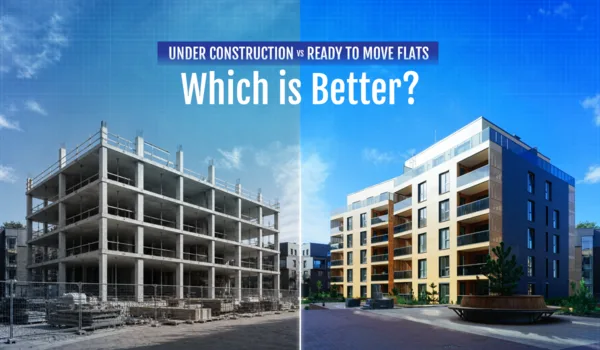
Two buyers can look at the same locality and walk away with very different deals, simply because one chose an under-construction flat and the other a ready-to-move one. The choice is not just about how soon you get the keys. It changes the tax you pay, the risk you carry, the way your loan behaves and even when you can start claiming a tax deduction. This guide lays out the real differences for a Bangalore buyer in 2026 — the GST that only one of them attracts, the Karnataka charges that apply to both, the protection you get if a project runs late, and the loan and tax timing that quietly favours the finished flat.
If you are still weighing whether to own at all, start with our buy vs rent analysis; and if you are comparing specific homes like Godrej Beacon in Yelahanka, our ready-to-move and pre-launch guides list what is available in each stage.
The Big One — GST Only Applies to Under-Construction
This is the difference most buyers underestimate. Under-construction property attracts GST; a completed, ready-to-move flat does not. For an under-construction home the rate is 5% of the price without input tax credit for a normal (non-affordable) flat, and 1% without input tax credit for an affordable one. A home counts as affordable only when it meets both tests: a carpet area up to 60 sq m in a metro (90 sq m in a non-metro) and a price up to ₹45 lakh. Most Bangalore apartments cross the price test, so the 5% rate is what usually applies.
A ready-to-move flat that has already received its completion certificate or occupancy certificate before you buy carries no GST at all — the sale of a completed building is treated as a transfer of immovable property, which is outside GST. The same is true of a resale or secondary-market flat. On an ₹80 lakh non-affordable home, that 5% is ₹4 lakh of GST on the under-construction version that simply does not exist on the finished one. It is the single biggest reason a ready flat can end up costing less than its higher sticker price suggests.
The zero-GST status depends on the completion or occupancy certificate having been issued before the sale. A flat marketed as “ready” but without an issued certificate can still legally attract 5% GST — so ask to see the certificate, not just the show flat.
The Charges That Apply to Both — Stamp Duty & Registration
Stamp duty and registration are payable whether the flat is under-construction or ready, because they are charged on the sale deed, not on the construction stage. In Karnataka in 2026 the stamp duty is 5% for a property above ₹45 lakh, 3% between ₹21 lakh and ₹45 lakh, and 2% below ₹20 lakh. The point buyers most often get wrong is the registration fee: it was raised from 1% to 2% with effect from 31 August 2025 — the first revision in over two decades — so anyone quoting “1% registration” is working off an old figure. On top of these, within BBMP limits a cess and a small surcharge apply on the stamp duty, taking the effective all-in cost for a flat above ₹45 lakh to roughly 7.5% to 7.6% of the value. All of it is levied on the higher of the actual price or the government guidance value. Our stamp duty and registration guide works through the calculation in full.
The Cost Gap — And Why the Sticker Price Misleads
Under-construction flats usually carry a lower base price than a comparable ready one — a discount often quoted in the region of 10% to 30%, though that is a market rule of thumb, not a fixed figure, and it narrows as a project nears completion. The trade-off is that you then add 5% GST on top and wait for possession. A ready flat has no GST and no waiting, but a higher base price and an immediate outflow of stamp duty, registration and full EMIs. The honest way to compare two options is to build the all-in cost for each — base price, plus GST where it applies, plus the same stamp duty and registration on both — rather than the headline price. Once GST is folded in, the gap between the two often shrinks far more than buyers expect.
Risk — What You Trade for the Discount
The lower entry price of an under-construction flat is, in part, compensation for risk. You are buying a promise: the project has to be finished, on time, to the spec and quality that were marketed. The things that can go wrong are delivery delay, a developer running short of funds, or changes to the layout, amenities or materials. A ready flat removes almost all of this — what you see is what you buy, you can inspect the actual unit, and you can move in or rent it out immediately.
This is exactly where RERA matters, and why verifying registration is non-negotiable for an under-construction purchase. Under the Real Estate (Regulation and Development) Act, a project in Karnataka with more than 8 units or on a plot larger than 500 sq m must be registered with the state authority before it is marketed. Registration brings real protections:
- Escrow discipline — 70% of the money buyers pay must sit in a dedicated project account and be used only for that project, limiting fund diversion.
- Delay remedy — if the developer misses the committed possession date, the buyer can either withdraw and claim a full refund with interest, or stay on and claim interest for every month of delay.
- Defect liability — structural or workmanship defects flagged within five years of possession must be rectified by the developer.
- Disclosure — the registered project details, approvals and timelines are on the public RERA record for you to check.
Before you pay a rupee for an under-construction flat, confirm the RERA number and read the record — our guide to verifying a RERA registration shows exactly how. A ready flat with an occupancy certificate has already cleared the construction risk RERA is designed to manage.
The Loan & Tax Timing — Pre-EMI vs Full EMI
How your home loan behaves also differs. On an under-construction flat the bank disburses the loan in stages as construction progresses, and you typically pay pre-EMI — interest only on the amount disbursed so far — until the property is ready, on top of any rent you are still paying elsewhere. On a ready flat the full loan is disbursed at once and you begin paying a full EMI of principal plus interest straight away, but you also occupy or let out the home immediately.
The tax timing follows the same logic. Interest you pay during construction is not deductible while the flat is being built. It is accumulated as “pre-construction interest” and then claimed in five equal annual instalments starting from the year you get possession, under Section 24(b) — and it still has to fit inside the ₹2 lakh self-occupied cap along with your current-year interest. A ready flat lets you start claiming the interest deduction from year one. Remember, too, that these interest and principal deductions exist only under the old tax regime; the new regime, now the default, does not allow them for a self-occupied home. We cover this fully in our home loan tax benefits guide and the wider home loan guide.
One rule applies identically to both: if the price is ₹50 lakh or more, the buyer must deduct 1% TDS under Section 194-IA on the amount paid to the seller and deposit it against the seller's PAN.
Side by Side
| Factor | Under-Construction | Ready-to-Move |
|---|---|---|
| GST | 5% (1% if affordable), no input tax credit | Nil, if completion/occupancy certificate issued |
| Base price | Usually lower (indicative 10–30%), narrows near completion | Higher, but no GST added |
| Stamp duty & registration (Karnataka) | Same — 5% duty + 2% registration + BBMP cess | Same — 5% duty + 2% registration + BBMP cess |
| Possession | After construction — delay risk | Immediate |
| Key risk | Delay, developer default, spec changes — RERA protected | Minimal — what you see is what you get |
| Loan & EMI | Staged disbursal, pre-EMI during construction | Full disbursal, full EMI from day one |
| Interest tax benefit (old regime) | Claimed only after possession, in 5 instalments | From the first year |
| TDS u/s 194-IA | 1% if price ≥ ₹50 lakh | 1% if price ≥ ₹50 lakh |
So Which Should You Choose?
There is no universally right answer — it depends on your timeline, your risk appetite and your cash flow. An under-construction flat can suit a buyer who is not in a hurry to move, wants a lower entry price and a wider choice of units and floors, and is comfortable doing the RERA due diligence and carrying the delay risk. A ready-to-move flat suits a buyer who needs to occupy soon or start earning rent, wants to avoid the 5% GST and the uncertainty, and is happy to pay a higher base price for certainty. Whichever way you lean, compare the two on all-in cost rather than sticker price, insist on seeing the RERA record for anything unfinished and the occupancy certificate for anything “ready”, and check your loan and tax position before you commit.
To weigh these options against a specific home and your own budget, get in touch for details, and read the finance and legal guides linked above first.
Frequently Asked Questions
1. Is there GST on a ready-to-move flat in 2026?
No. A ready-to-move flat that has received its completion or occupancy certificate before the sale carries no GST, because it is treated as a transfer of immovable property. GST of 5% (or 1% for affordable housing), without input tax credit, applies only to under-construction property. Confirm the certificate has actually been issued, as a flat marketed as ready without one can still attract GST.
2. How much cheaper is an under-construction flat?
The base price of an under-construction flat is usually lower than a comparable ready one — often quoted around 10% to 30%, though that is a market rule of thumb, not a fixed figure, and the gap narrows as the project nears completion. Remember to add 5% GST to the under-construction price before comparing, which shrinks the effective saving.
3. What are the stamp duty and registration charges in Karnataka?
Stamp duty is 5% above ₹45 lakh, 3% between ₹21 and ₹45 lakh and 2% below ₹20 lakh. The registration fee was raised from 1% to 2% with effect from 31 August 2025. With the BBMP cess and surcharge, the effective all-in cost for a flat above ₹45 lakh comes to roughly 7.5% to 7.6%. These apply equally to under-construction and ready flats.
4. What protection do I have if an under-construction project is delayed?
If the project is RERA-registered and the developer misses the committed possession date, you can either withdraw and claim a full refund with interest, or continue and claim interest for each month of delay. RERA also requires 70% of buyer payments to be held in a dedicated project account and covers structural defects for five years. Always verify the RERA registration before you buy.
5. When can I claim the tax deduction on an under-construction flat?
Interest paid during construction is not deductible while the flat is being built. It is accumulated and then claimed in five equal annual instalments from the year you get possession, under Section 24(b), within the ₹2 lakh self-occupied limit. A ready flat lets you claim from the first year. These benefits apply only under the old tax regime.
6. Do I pay TDS on both under-construction and ready-to-move purchases?
Yes. If the property price is ₹50 lakh or more, the buyer must deduct 1% TDS under Section 194-IA on the amount paid to the seller and deposit it against the seller's PAN, regardless of whether the flat is under-construction or ready. This is separate from GST and from stamp duty.
Conclusion
The under-construction versus ready-to-move decision is really a trade between price and certainty. Under-construction offers a lower entry price and more choice, but adds 5% GST, makes you wait, and asks you to carry — and verify away — the risk of delay through RERA. Ready-to-move costs more on paper yet skips the GST, removes the construction risk and lets you occupy or earn rent at once, with the tax benefit starting immediately. Stamp duty, the 2% registration fee and 1% TDS fall on both. Compare the two on all-in cost rather than sticker price, check the RERA record or the occupancy certificate as the case demands, and line the choice up against your loan and tax position before you sign.
To map this against a specific home, read our home loan guide and the buyer guides linked above before you commit.
Godrej Beacon Blog