NRI Guide to Buying Property in Bangalore 2026
The rules, rates and tax figures below are indicative for 2026 and change with the Budget and RBI circulars — confirm the current position with your bank, a chartered accountant and a property lawyer before you act.

Buying a home in Bangalore as a Non-Resident Indian is entirely doable — the city is one of the most popular destinations for NRI property money — but it runs on a separate set of rules from a resident purchase. The Foreign Exchange Management Act (FEMA) governs what you can buy and how you must pay for it, the tax on any future sale is deducted differently, and there is paperwork — PAN, a power of attorney, the right kind of bank account — that is best sorted before you sign anything. This guide walks through what an NRI or OCI needs to know to buy a Bangalore apartment in 2026, and flags the points where professional advice is not optional.
If a specific home like Godrej Beacon in Yelahanka is on your list, the financing and the statutory costs work the same way for you as for a resident buyer — our home loan guide and stamp duty and registration guide both apply. For the wider market, see our Yelahanka apartment guide.
Can an NRI or OCI Buy Property in Bangalore?
Yes. Under FEMA, an NRI or an Overseas Citizen of India (OCI) can freely buy residential and commercial property in India, with no cap on the number of properties and no special permission from the Reserve Bank of India needed. What is not allowed is buying agricultural land, a farmhouse or plantation property — these cannot be purchased or received as a gift, and can only come to you by inheritance. For a standard Bangalore apartment or a commercial unit, you are on the permitted list.
| Property type | Can an NRI/OCI buy? |
|---|---|
| Residential apartment or house | Yes |
| Commercial property | Yes |
| Agricultural land | No (inheritance only) |
| Farmhouse | No (inheritance only) |
| Plantation property | No (inheritance only) |
How You Must Pay — FEMA Banking Rules
This is the rule NRIs most often trip over. Payment for the property must move through normal banking channels — either an inward remittance from abroad, or funds already held in your NRE, NRO or FCNR(B) account in India. Paying in foreign currency notes, travellers’ cheques or cash is expressly prohibited. In practice that means the money for the down payment, the EMIs and the charges should be routed through one of these rupee accounts, and you should keep the remittance records — they matter later when you want to repatriate the sale proceeds. The account you use also affects how freely the money can go back out of India, so it is worth planning before the first payment, not after.
Home Loans for NRIs
Indian banks and housing finance companies lend to NRIs and OCIs much as they do to residents. You can typically borrow up to about 75% to 90% of the property value depending on the loan size and lender, over a tenure that is usually capped by your age at maturity rather than a fixed number of years. The EMIs must be serviced from your NRE or NRO account or through inward remittance, not from an overseas account directly. Rates track the same benchmark as resident loans — floating home-loan rates broadly sat in the 7.25% to 9% range through 2026, following an RBI repo rate held at 5.25% at both the April and June 2026 policy meetings. Expect lenders to ask for more documentation than from a resident: passport and visa or OCI card, overseas address proof, income and employment papers, and often a power of attorney holder in India.
PAN, Power of Attorney and the Paperwork
A PAN card is mandatory for the purchase and for the tax filings that follow — you cannot register a property or handle the TDS without one. Aadhaar is not mandatory for an NRI living abroad. If you cannot be physically present for registration — which is common — you will execute a Power of Attorney (PoA) in favour of someone in India. A PoA signed abroad has to be notarised in your country of residence and then either apostilled (for countries in the Hague Convention, such as the US, UK and Australia) or attested by the Indian embassy or consulate (for others, such as the UAE), and then stamped and used in India within the validity the sub-registrar accepts. Getting the PoA wording and attestation right matters — a defective PoA can stall the registration — so have it drafted by a property lawyer rather than copied from a template.
Tax and TDS When You Buy
When an NRI is the buyer, the TDS you must deduct depends on who you are buying from:
- Buying from a resident seller: deduct 1% TDS under Section 194-IA if the price is ₹50 lakh or more, and deposit it against the seller’s PAN.
- Buying from another NRI seller: deduct TDS under Section 195 on the seller’s capital gain — there is no ₹50 lakh threshold here, and the rate is far higher than 1% (long-term capital gains are taxed at 12.5% plus surcharge and cess, so the effective deduction runs to roughly 15% or more). This is a common and expensive mistake — treat a purchase from an NRI seller very differently from one from a resident.
A recent easing worth noting: the buyer deducting TDS on a purchase from an NRI can now use their PAN instead of a TAN, which removes a step that used to catch buyers out. Because Section 195 involves the seller’s capital-gains computation, both sides usually engage a chartered accountant and, where useful, apply for a lower-deduction certificate. Do not guess the rate here.
Stamp Duty and Registration
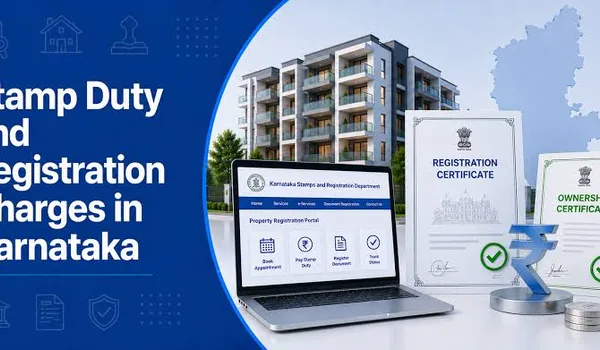
There is no NRI surcharge on stamp duty — you pay the same rates as a resident buyer in Karnataka. As of 2026 that means stamp duty of 5% on properties above ₹45 lakh (with lower slabs below that), plus a registration fee that was raised to 2% (from 1%) with effect from 31 August 2025, and cess on top — an all-in figure of roughly 6.6% of the property value. Our stamp duty and registration guide works through the slabs and a sample calculation.
Repatriating the Sale Proceeds
The other half of an NRI purchase is getting the money back out when you eventually sell. The headline rules for 2026: from your NRO account you can repatriate up to USD 1 million per financial year (in aggregate, across all your NRO balances), after the applicable taxes are paid and the bank has your Form 15CA and a chartered accountant’s Form 15CB. Where the property was originally bought with foreign funds routed through your NRE or FCNR account, the sale proceeds up to that original amount are repatriable, and the principal can be repatriated for up to two residential properties. Property bought with rupee or NRO funds falls under the USD 1 million annual cap regardless of how many properties are involved. These limits and the paperwork are exactly why routing every payment cleanly through the right account from day one pays off — confirm the current position with your bank and CA before you sell.
A Practical Checklist Before You Buy
- Confirm you have a valid PAN and, if buying remotely, a properly attested power of attorney.
- Open or identify the right NRE / NRO / FCNR account and route all payments through it — keep the remittance records.
- Check the property’s title, approvals and, for a pre-launch, its RERA registration — see our RERA verification guide.
- If buying from an NRI seller, sort out Section 195 TDS with a CA before you pay — not after.
- Budget for the full ~6.6% stamp duty and registration on top of the price.
- Engage a property lawyer and a chartered accountant early — the cost is small against the amount at stake.
When you are ready to price a specific home and map the paperwork against your own situation, get in touch for details.
Frequently Asked Questions
1. Can an NRI buy an apartment in Bangalore?
Yes. Under FEMA an NRI or OCI can freely buy residential and commercial property in India with no cap on the number of properties and no RBI permission needed. Only agricultural land, farmhouses and plantation property are off-limits — those can come to an NRI only through inheritance.
2. How must an NRI pay for the property?
Through normal banking channels only — an inward remittance from abroad or funds in an NRE, NRO or FCNR account in India. Paying in foreign currency notes, travellers’ cheques or cash is not allowed. Keep the remittance records, as they matter when you later repatriate the sale proceeds.
3. Can NRIs get a home loan in India?
Yes. Indian banks and housing finance companies lend to NRIs and OCIs, typically up to about 75% to 90% of the value, with EMIs serviced from an NRE or NRO account or by inward remittance. Rates track the same benchmark as resident loans, broadly 7.25% to 9% through 2026. Lenders ask for more documents, including passport, visa or OCI card and often a power of attorney.
4. What TDS applies when an NRI buys property?
It depends on the seller. Buying from a resident, you deduct 1% under Section 194-IA if the price is ₹50 lakh or more. Buying from another NRI, you deduct TDS under Section 195 on the seller’s capital gain — there is no ₹50 lakh threshold and the rate is much higher (around 15% or more for long-term gains). Use a chartered accountant for a purchase from an NRI seller.
5. Do NRIs pay higher stamp duty in Karnataka?
No. NRIs pay the same stamp duty and registration as residents — there is no NRI surcharge. In Karnataka for 2026 that is roughly 6.6% of the value all-in, including the registration fee raised to 2% from 31 August 2025.
6. Can an NRI take the money out of India after selling?
Largely yes, within limits. You can repatriate up to USD 1 million per financial year from an NRO account after taxes and the required Form 15CA/15CB. Where the property was bought with foreign funds through an NRE or FCNR account, proceeds up to that original amount are repatriable, and the principal can be repatriated for up to two residential properties. Confirm the current rules with your bank and CA.
Conclusion
Buying property in Bangalore as an NRI is well-trodden ground, but it rewards planning. Get the mechanics right from the start — a valid PAN, a properly attested power of attorney, and every rupee routed through the correct NRE, NRO or FCNR account — and the purchase itself is much like a resident’s. Where NRIs get caught out is the tax on a future sale, the higher TDS when buying from another NRI, and the repatriation paperwork, all of which reward getting a chartered accountant and a property lawyer involved early rather than late. Do that, verify the home’s title and approvals, and a Bangalore apartment can be a straightforward addition to an NRI portfolio.
To price a specific home and see whether the finance stacks up, read our buy vs rent analysis and the finance guides linked above before you commit.
Godrej Beacon Blog